
Freedom from Frequent Frustration
Next session: Wed, May 6, 2026 (12:00PM–3:30PM Eastern)
Earlybird deadline: Fri, May 1, 2026 at 5:00PM Eastern
 3.0 hours | 100% over Zoom

Date options below
Significant earlybird savings

All workshops are held c/o Zoom, with its terrific convenience, fancy polls, easy breakouts—and legendary flexibility in pantwear.
Workshop overview
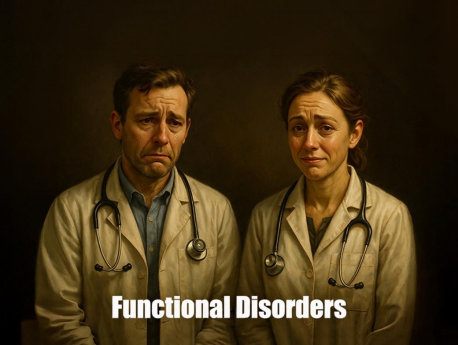
Functional disorders are among the most prevalent and perplexing conditions in medicine. Fortunately, CBT can help. It's all in your head that no treatment is helpful.

The terminology is maybe medicine's most muddled. Hysteria, hypochondriasis, psycho-somatic, psychogenic, somatization, somatoform, non-organic, bodily distress, health anxiety, and MUS all describe similar or overlapping phenomena, depending on your country, your speciality, and your era. DSM-5 well-meaningly contributed the term somatic symptom disorder—only to give everyone a massive, psychogenic headache.
Luckily, CBT doesn’t require perfect diagnostic labels to be effective—only a shared recognition that symptoms are real, patterns are identifiable, and change is possible. We cover nine conditions that range from textbook functional to biologically entangled, but all with strong evidence for CBT-based relief:
- Dementia worry. Fear of dementia—especially among older adults with normal forgetfulness—is increasingly common in primary care. CBT shows considerable promise in reducing distress and ruminative worry. We'll show you how to address these concerns with empathy, structure, and cognitive tools that don’t require an MRI.
- Fibromyalgia. Chronic widespread pain? Exhaustion? Normal tests? You’re likely dealing with fibromyalgia. CBT won’t cure it—but several dozen RCTs and Cochrane reviews show it can improve quality of life, pain interference, and mood. We’ll walk you through pacing strategies, cognitive reframing, and sleep-focused modules that patients find surprisingly useful.
- Illness anxiety. Illness anxiety disorder sufferers (aka hypochondriacs) can drive the Good Doctor nuts—but they needn't. Over 28 RCTs (and 5 meta-analyses) attest to CBT being very helpful for the condition—including for the fear of cancer recurrence (FCR). We go through the most practical interventions for your clinic.
- Irritable bowel syndrome. If your patient says, “My gut controls my life,” CBT can help them take it back. Over 40 RCTs—and NICE guidelines—support CBT for IBS. The gains? Reduced symptom severity, fewer flare-ups, and a lot less catastrophizing about the bathroom.
- Migraine headaches. CBT won’t replace your triptans, but it can reduce frequency and intensity of migraines, especially for patients whose stress and perfectionism drive their attacks. Evidence is moderate but growing, especially when paired with biofeedback or behavioral pacing. We’ll show you targeted strategies for migraine-prone minds.
- Panic. Physicians trained in CBT can derive significant satisfaction from treating panic for good reason: most patients respond relatively quickly—and relapse rates are reassuringly low. Panic disorder can be treated the British way (Oxford's model) or the American way (BU's model). We're Canadian, so naturally we hono(u)r and teach both. Happily, the science says that six appointments will often suffice—and we'll teach you exactly what to do.
- Perimenopausal symptoms. CBT can’t regulate estrogen—but it can help with hot flashes, sleep problems, and mood swings. Recent RCTs show real benefit, and NICE recommends it for vasomotor and emotional symptoms. You'll learn how to help patients reframe the menopausal transition—not as a hormonal apocalypse, but as something they can handle.
- Premenstrual dysphoric disorder. PMDD can make patients feel hijacked by their own bodies every month. CBT is emerging as a helpful adjunct or alternative to SSRIs. We’ll walk you through protocols that bring structure and sanity to the luteal phase.
- Tinnitus. Tinnitus is rarely dangerous—but often maddening. Fortunately, CBT has solid evidence for reducing distress and improving functioning, even if the ringing stays.
If you’re tired of saying, “I don’t know what else to tell you", the Functional Disorders module is for you. We’ll arm you with practical, structured, evidence-based CBT tools to treat some of the toughest “nothing found” conditions in primary care—without needing a psychiatry degree or twenty extra minutes per visit. You’ll leave with confidence, strategies, and maybe even a renewed sense of clinical joy. Register now and become the doctor who can often offer genuine relief for functional disorders, and not just another bewildered shrug.
Many maladies show no organic fault, arising instead from the mind’s hidden torments
—Philippe Pinel (1745–1826)
Head instructor Greg Dubord, MD is the CME Director of CBT Canada, and the prime developer of medical CBT. He has presented over 500 workshops, including over 50 for the College of Family Physicians of Canada, and is a University of Toronto CME Teacher of the Year.

| Physicians | Allied health | Residents | |
| Earlybird tuition | $395 | $295 | $195 |
| Regular tuition | $495 | $395 | $295 |
| Last minute tuition | $595 | $495 | $395 |
Sponsors of CBT Canada's workshops have included the CFPC,
Dalhousie, McGill, McMaster, Memorial, Queen's, UAlberta,
UBC, UCalgary, UdeM, USask, UToronto, and Western (UWO).
Times below are Eastern
| Date & time All times Eastern |
Mainpro+ credits & duration |
Earlybird deadline | Workshop status |
| Sep 19, 2025 12:00PM–3:30PM |
9.0 credits 3.0 hours |
Sep 12 save $200 |
COMPLETED |
| Oct 29, 2025 12:00PM–3:30PM |
9.0 credits 3.0 hours |
Oct 24 save $200 |
COMPLETED |
| Dec 10, 2025 12:00PM–3:30PM |
9.0 credits 3.0 hours |
Dec
5 save $200 |
COMPLETED |
| May 6, 2026 12:00PM–3:30PM |
3.0 credits 3.0 hours |
May 1 save $200 |
REGISTER NOW |
If you ever need to cancel your registration for any reason whatsoever, you may transfer 100% of your tuition to another workshop without any penalty, or receive a full refund minus a 25% processing fee (policy).
Kind words
Feedback from the precursor Panic Disorder workshop
* Well presented, with clear & practical tips. Excellent overall. —Wendy Johnsen, MD, FCFP (Port Alberni, BC)
* Witty and upbeat. I think it's essential for daily practice as a family doctor. It is so relevant. —Patrick Bailey, MD, CCFP (Calgary, AB)
* Great pearls & handouts... I could have saved so much time with so many patients. —Christiana Yao, MD, FCFP (Ottawa, ON)
* Very relevant and practical. Signing up for more! —Ellise Morley, MD, FCFP (St. Albert, AB)
* If I'd had this workshop earlier, I'd definitely have helped my patients better—I would have had a better work-life balance. —Uchenna Aloke, MD, FCFP (Lloydminster, SK)
* Very relevant and practical suggestions with clinical applications. I would have benefited immensely with this training at the outset of my medical career. It would have made managing patient encounters so much easier and it has helped me personally as well. —Cheryl Hume, MD, FCFP (Lake Country, BC)
* I now have more knowledge to truly help patients. A great workshop as usual! —Sophie Giraldeau, MD, FCFP (Montreal, QC)
* I wish I'd taken this earlier! I would have been more effective in managing mental health issues and felt less stress about doing it. —Deborah-Lee O'Connor, MD, FCFP (Sudbury, ON)
* Practical, real-life information. I always learn something new from each workshop. —Krista Bradley, MD, FCFP (Kamloops, BC)
* Great presenter, concretely useful advice and information. Life would have been an order of magnitude better at work and at home if I would have had CBT training earlier in my career. —Tim Erickson, MD, CCFP (Spruce Grove, AB)

Many physician leaders have been trained by CBT Canada over the past 30 years. Alumni include CFPC presidents (both national & provincial), department chairs, residency training program directors—and even a few doctors who can juggle drills & saws. For a compilation of testimonials, click here.

CBT Canada won the National CME Program Award from the College of Family Physicians of Canada for providing "exceptional learning experiences". CBT Canada was also the first organization to be authorized by the CFPC to provide three-credits-per-hour CME. One accreditation reviewer wrote, "Two words: superlative & exemplary".
 Print
Print