
The CFPC's New CME System:
What You Lose on December 31
Protect your time and quality CME
Nearly 500 physicians have united to demand the preservation of three-credit-per-hour CME in 2026.
EMAIL THE PRESIDENT >>>The Policy Shift: What is Changing & Why
1. What exactly is the CFPC changing about CME credits? Effective December 31, 2025, the CFPC plans to eliminate a tiered CME system that has existed since the launch of Mainpro-C in 1999. All programs that currently earn three-credits-per-hour will be reduced to one-credit-per-hour regardless of quality, interactivity, or pedagogical sophistication.
2. Why should this matter to me as a practicing physician? If you currently rely on three-credit-per-hour programs to meet your 250-credit requirement over five years, this change will triple your time commitment from approximately 83 hours to 250 hours per cycle—an additional 167 hours, or roughly 30 full working days, that you’ll be forced to devote to CME instead of patient care or personal time.
3. What quality distinction is being eliminated? Programs meeting rigorous standards for instructional design currently count for additional credits per hour, recognizing that intensive, well-designed educational experiences produce superior learning outcomes. The burden has been on CME providers to create exceptional programs—not on individual physicians to complete extra homework.
4. What reasons has the CFPC given for this change? The CFPC has provided two official reasons for eliminating multiple-credit-per-hour CME (link): a) Only a handful of providers have met the highest standards; and b) Some physicians have complained of "stranded credits" when they don't complete all required elements.
In addition, a CFPC form letter (Oct 19, 2025; copy on file) cited two further reasons: c) The "number of credits is not a highly ranked motivator for choosing CPD"; and d) There's "an unfair situation in which [Québec] physicians are not able to claim more than one credit per hour."
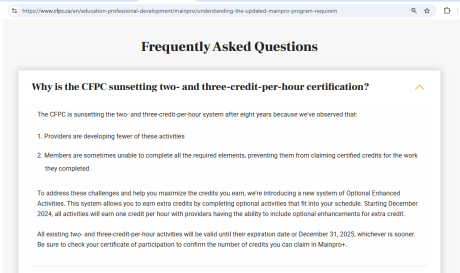
Reality Check:
a) "Only a handful of providers meet high standards". Rising to the challenge of creating good CME is difficult. That's not a reason to discontinue the incentives—it's a reason to help more providers meet them.
b) "Stranded credits problem". This was never an issue for us despite over 10,000 attendees. When physicians were late with paperwork, we simply walked them through it.
c) "Credits not a highly ranked motivator". Credits are obviously a motivator for physicians taking CME. Look at any CME advertisement—credit counts are featured prominently because they drive enrollment.
d) "Unfair to Québec physicians". It's accepted that Québec has a distinct approach to the professions (e.g., Bill 2). However, by eliminating three-credit-per-hour CME, the CFPC would be unique in forcing all the rest of Canada to match Québec's preferences.
5. Doesn't the CFPC claim they've "raised baseline standards"? It has, marginally—but it has also eliminated the incentives to excel. The CFPC doesn’t just want to raise the floor (good); it wants to crush down the ceiling (bad). In our October 2025 survey, 100% of physicians rated this approach as wrong. Credit-flattening = quality flattening.
6. Is the new system "simpler"? Physicians who were frustrated with the clunky old platform just wanted new software. However, in no way, shape, or form should the CFPC have conflated that with a request to have compulsory CME time tripled.
The Consequences: Workload, Quality & Patient Care
7. How does this affect my workload? If you complete CME efficiently using three-credit-per-hour programs, you'll need an additional 167 hours per five-year cycle—time that nearly 90% of physicians rated as unmanageable. That’s 30 working days lost to CME instead of serving patients, resting, or spending time with family. Patients don't benefit when doctors sit longer; they benefit when doctors learn better.
8. What will happen to CME quality under the new system? Over three-quarters of surveyed physicians predict quality will decline if all programs earn identical credits. Without a tiered system, the most conscientious providers lose a key motivator. After all, why invest the extra effort to make a program engaging and evidence-based when it will only count for the same credits as so-called “robo CME”—prepackaged, low-interaction content delivered at volume? The CFPC's new policy favors inexpensive, automated programs over rigorous, faculty-led learning. The College is turning back the clock on evidence-based CME.
9. Did the CFPC consult physicians, or CME providers? In our survey of 109 family physicians (October 2025), every single respondent—100%—reported never being consulted about eliminating three-credit-per-hour CME. The CFPC claims it “attempted over the last two years to engage providers,” yet this has not been our experience nor that of other long-standing programs who similarly report zero consultation before the change was announced as a fait accompli. The CFPC’s subsequent “engagement” has been limited to directives on transitioning to the new one-credit-per-hour system, and not remotely a dialogue.
The CFPC’s pattern of announcing major changes without meaningful consultation mirrors the PGY-3 debacle, when it was forced to abandon its plan to extend residency training after widespread member opposition.
10. What are the real-world effects of this change? The heavy lifting once done by CME developers to create credit-rich programs now falls to individual physicians completing "optional enhanced activities" (i.e., homework) on their own time. As physicians spend more hours meeting CME requirements, underserved communities lose access, and patient care declines when seat time replaces skill development. Forcing burned-out doctors to complete unnecessary hours harms patients through reduced clinic access.
11. Do physicians want to keep the three-credit-per-hour option? Yes—and unanimously. In our October 2025 survey, 100% of physicians said they want to preserve their right to choose three-credit-per-hour CME. Physicians are clear: they expect the CFPC to uphold educational choice and continue recognizing quality distinctions through tiered credit allocation. The system worked effectively for 26 years and required no change.
12. Take Action: Email President Sarah Cook, MD
TO: scook@cfpc.ca
SUBJ: Preserve three-credit-per-hour CME
Dear Dr. Cook,
As the CFPC President, I urge you to preserve the evidence‑based three‑credit‑per‑hour CME designation, which has effectively incentivized high‑quality education for so many years.
Flattening everything to one‑credit‑per‑hour will add up to 167 hours (30 workdays) per five‑year cycle for physicians who rely on intensive programs—exacerbating burnout and removing thousands of hours from patient care during a national family doctor shortage affecting 6.5 million Canadians.
Please provide:
- Peer-reviewed evidence showing that passive learning (e.g., CFPCLearn podcasts) achieves outcomes equivalent to interactive, expert-led workshops.
- The survey showing that CFPC members supported eliminating 26 years of quality distinctions. If no such survey exists, please explain how this change aligns with the CFPC's member-serving mandate
- An explanation of why Quebec physicians’ inability to claim more than one credit per hour should dictate a lower national policy for all, rather than finding a solution for Quebec.
I am deeply concerned that credit‑flattening risks both educational excellence and patient care.
Please reply at your earliest convenience, as I need to plan my CME for 2026. Please also ensure that my email and your response are shared with the CFPC Board and the National Committee on Continuing Professional Development.
Respectfully,
[name & city]
Keep 3:1
Less time, more skill, better care
Nearly 500 physicians have already spoken
Not a single physician supported the
elimination of quality-based certification
 Print
Print